


Page 90 - Reggae Festival Guide Magazine 2019
P. 90
official  push  than  the  music  industry’s  effort

                                                                                a  decade  later,  which  succeeded  in  bringing
                                                                                reggae to the states.


                                                                                For the most part, this is not a history of ska, born

                                                                                in the ghetto of Kingston, a subject the author

                                                                                has treated in two previous works. Instead, it
                                                                                is a story of the promotion and marketing of

                                                                                the music, first in “uptown” Jamaica and then

                                                                                in the United States, as a new style of music
                                                                                and as one of the “dance crazes” that swept the

                                                                                early ‘60s. As a result, the book deals more with

                                                                                the  likes  of  anthropologist-turned-politician
                                                                                Edward Seaga, dancer-turned-manager Ronnie

                                                                                Nasralla  and  musician-turned-cultural  icon

                                                                                Byron Lee and his band – than the musicians,
                                                                                artists  and  producers  who  created  the  music

                                                                                in the first place. Nonetheless, it’s a fascinating

                                                                                window  into  the  earliest  penetration  of
                                                                                Jamaican  music  into  upper-class  Jamaican

                                                                                society,  New York  and  eventually  America  at

                                                                                large. Some of the best parts come from the
                                                                                author’s  own  interviews,  including  a  lengthy

                                                                                and  engaging  discussion  with  ska’s  greatest
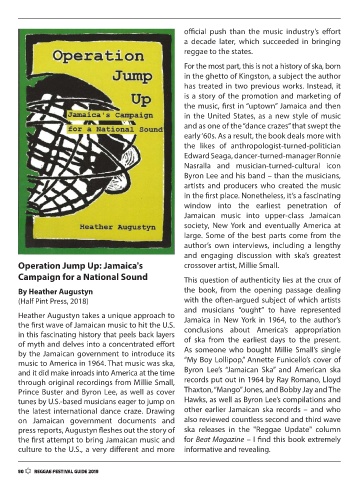
         Operation Jump Up: Jamaica's                                           crossover artist, Millie Small.


         Campaign for a National Sound                                          This question of authenticity lies at the crux of

         By Heather Augustyn                                                    the  book,  from  the  opening  passage  dealing

         (Half Pint Press, 2018)                                                with the often-argued subject of which artists
                                                                                and  musicians  “ought”  to  have  represented
         Heather Augustyn takes a unique approach to                            Jamaica  in  New York  in  1964,  to  the  author’s
         the first wave of Jamaican music to hit the U.S.                       conclusions  about  America’s  appropriation

         in this fascinating history that peels back layers
         of myth and delves into a concentrated effort                          of  ska  from  the  earliest  days  to  the  present.

         by the Jamaican government to introduce its                            As  someone  who  bought  Millie  Small’s  single

         music to America in 1964. That music was ska,                          “My Boy Lollipop,” Annette Funicello’s cover of
         and it did make inroads into America at the time                       Byron  Lee’s “Jamaican  Ska”  and  American  ska

         through original recordings from Millie Small,                         records put out in 1964 by Ray Romano, Lloyd
         Prince Buster and Byron Lee, as well as cover                          Thaxton, “Mango” Jones, and Bobby Jay and The

         tunes by U.S.-based musicians eager to jump on                         Hawks, as well as Byron Lee’s compilations and
         the  latest  international  dance  craze.  Drawing                     other  earlier  Jamaican  ska  records  –  and  who

         on  Jamaican  government  documents  and                               also reviewed countless second and third wave
         press reports, Augustyn fleshes out the story of  ska  releases  in  the  "Reggae  Update"  column

         the first attempt to bring Jamaican music and  for Beat Magazine – I find this book extremely
         culture to the U.S., a very different and more  informative and revealing.


         90     Reggae Festival guide 2019

