


Page 93 - Reggae Festival Guide Magazine 2019
P. 93
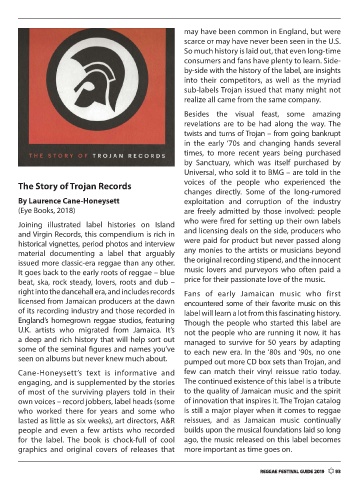
may have been common in England, but were

                                                                                scarce or may have never been seen in the U.S.
                                                                                So much history is laid out, that even long-time

                                                                                consumers and fans have plenty to learn. Side-

                                                                                by-side with the history of the label, are insights
                                                                                into  their  competitors,  as  well  as  the  myriad

                                                                                sub-labels Trojan issued that many might not
                                                                                realize all came from the same company.


                                                                                Besides  the  visual  feast,  some  amazing

                                                                                revelations  are  to  be  had  along  the  way. The
                                                                                twists and turns of Trojan – from going bankrupt

                                                                                in  the  early ‘70s  and  changing  hands  several
                                                                                times,  to  more  recent  years  being  purchased

                                                                                by  Sanctuary,  which  was  itself  purchased  by

                                                                                Universal, who sold it to BMG – are told in the

         The Story of Trojan Records                                            voices  of  the  people  who  experienced  the
                                                                                changes  directly.  Some  of  the  long-rumored
         By Laurence Cane-Honeysett                                             exploitation  and  corruption  of  the  industry

         (Eye Books, 2018)                                                      are  freely  admitted  by  those  involved:  people


         Joining  illustrated  label  histories  on  Island                     who were fired for setting up their own labels
         and Virgin Records, this compendium is rich in                         and licensing deals on the side, producers who

         historical vignettes, period photos and interview                      were paid for product but never passed along
         material  documenting  a  label  that  arguably                        any monies to the artists or musicians beyond

         issued more classic-era reggae than any other.                         the original recording stipend, and the innocent
         It goes back to the early roots of reggae – blue                       music  lovers  and  purveyors  who  often  paid  a

         beat, ska, rock steady, lovers, roots and dub –                        price for their passionate love of the music.
         right into the dancehall era, and includes records                     Fans  of  early  Jamaican  music  who  first

         licensed from Jamaican producers at the dawn                           encountered  some  of  their  favorite  music  on  this

         of its recording industry and those recorded in                        label will learn a lot from this fascinating history.
         England’s homegrown reggae studios, featuring                          Though the people who started this label are

         U.K.  artists  who  migrated  from  Jamaica.  It’s                     not the people who are running it now, it has
         a deep and rich history that will help sort out                        managed  to  survive  for  50  years  by  adapting

         some of the seminal figures and names you’ve                           to  each  new  era.  In  the ‘80s  and ‘90s,  no  one
         seen on albums but never knew much about.                              pumped out more CD box sets than Trojan, and


         Cane-Honeysett’s  text  is  informative  and                           few  can  match  their  vinyl  reissue  ratio  today.

         engaging, and is supplemented by the stories                           The continued existence of this label is a tribute
         of  most  of  the  surviving  players  told  in  their                 to the quality of Jamaican music and the spirit

         own voices – record jobbers, label heads (some  of innovation that inspires it. The Trojan catalog
         who  worked  there  for  years  and  some  who  is still a major player when it comes to reggae

         lasted as little as six weeks), art directors, A&R  reissues,  and  as  Jamaican  music  continually
         people  and  even  a  few  artists  who  recorded  builds upon the musical foundations laid so long

         for  the  label.  The  book  is  chock-full  of  cool  ago, the music released on this label becomes
         graphics  and  original  covers  of  releases  that  more important as time goes on.


                                                                                                                Reggae Festival guide 2019      93

