


Page 91 - Reggae Festival Guide Magazine 2019
P. 91
well as later reminisces. The band for the first tour

                                                                                included both Donald Kinsey and Chinna Smith
                                                                                on  guitar,  Junior  Marvin  took  over  lead  guitar

                                                                                duties on their return visit, and he was later joined
                                                                                by Al Anderson (with Marley himself providing

                                                                                rhythm  guitar  throughout).  Otherwise,  the
                                                                                touring unit included the Barrett Brothers, Seeco

                                                                                Patterson, Tyrone Downie (and Earl “Wire” Lindo

                                                                                on the later shows) and the I-Threes, plus a large
                                                                                entourage.  The  combined  descriptions  of  the

                                                                                shows from journalists, participants in the tour
                                                                                and audience members remind me of my own

                                                                                feelings about the live performances I personally
                                                                                experienced – that Bob Marley and the Wailers

                                                                                combined music, art, dance, spirituality, poetry,
                                                                                politics (of the social justice, not the divide-and-

                                                                                conquer kind) and performance in a way many
                                                                                have tried and at which few have succeeded.


                                                                                As  has  often  been  the  case,  very  little  actual

                                                                                interview material survives – the chasm between
                                                                                Bob’s Patois and the Dutch journalists’ English being


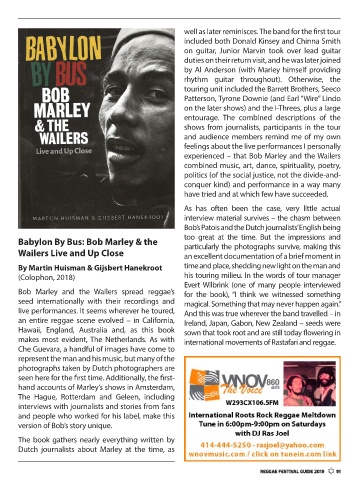
         Babylon By Bus: Bob Marley & the                                       too  great  at  the  time.  But  the  impressions  and
                                                                                particularly the photographs survive, making this
         Wailers Live and Up Close                                              an excellent documentation of a brief moment in


         By Martin Huisman & Gijsbert Hanekroot                                 time and place, shedding new light on the man and

         (Colophon, 2018)                                                       his touring milieu. In the words of tour manager
                                                                                Evert Wilbrink  (one  of  many  people  interviewed
         Bob  Marley  and  the  Wailers  spread  reggae’s                       for  the  book), “I  think  we  witnessed  something

         seed  internationally  with  their  recordings  and                    magical. Something that may never happen again.”

         live performances. It seems wherever he toured,                        And this was true wherever the band travelled – in
         an  entire  reggae  scene  evolved  –  in  California,                 Ireland, Japan, Gabon, New Zealand – seeds were

         Hawaii,  England,  Australia  and,  as  this  book                     sown that took root and are still today flowering in
         makes  most  evident, The  Netherlands.  As  with                      international movements of Rastafari and reggae.

         Che Guevara, a handful of images have come to
         represent the man and his music, but many of the

         photographs taken by Dutch photographers are
         seen here for the first time. Additionally, the first-

         hand accounts of Marley’s shows in Amsterdam,
         The  Hague,  Rotterdam  and  Geleen,  including

         interviews with journalists and stories from fans

         and people who worked for his label, make this
         version of Bob’s story unique.


         The book gathers nearly everything written by
         Dutch  journalists  about  Marley  at  the  time,  as


                                                                                                                Reggae Festival guide 2019       91

