This is a first-person recap subtitled HEARTBEAT OF THE RIVER – Reflections about Reggae on the River 2025 by Heather Rowbury of the Mateel Community Center’s 36th annual festival, County Line Ranch (formerly Dimmick Ranch), Humboldt County, California — August 1–3, 2025. Heather is a behind-the-scenes active reggae lover for almost 30 years as an avid fan, artist liason, guest media check in, street teamer, and more. Heather shares her love of Reggae on the River with us.
2026 FESTIVAL
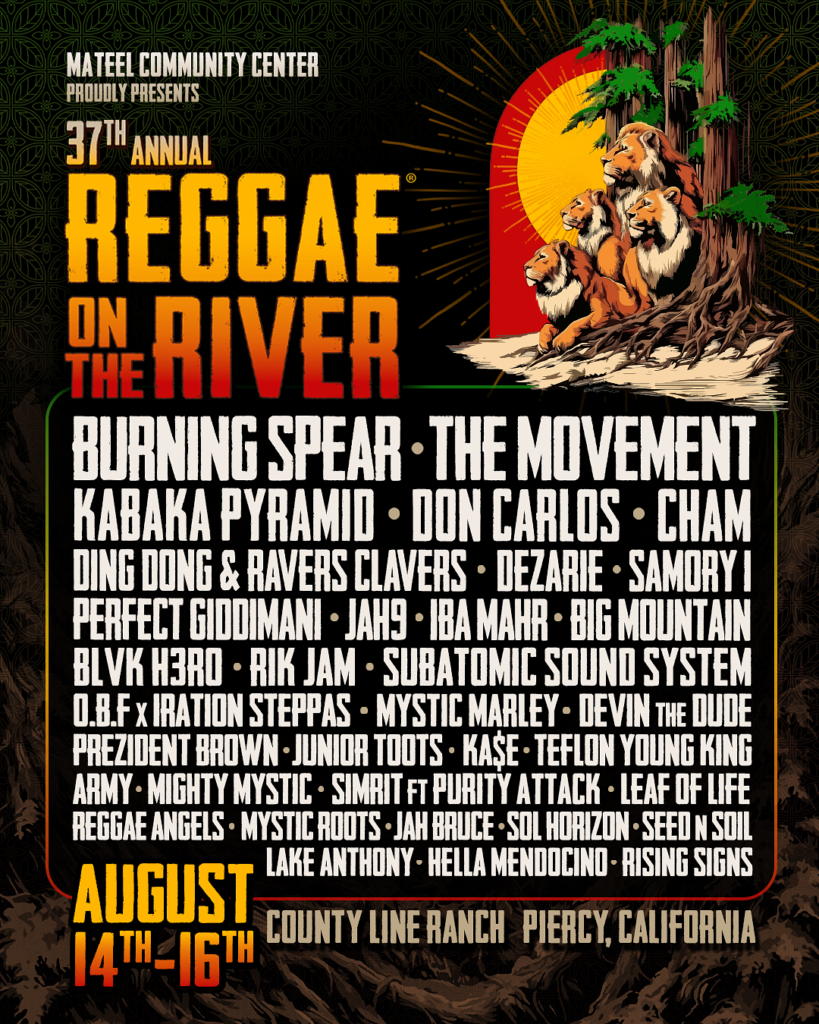
The 37th annual Reggae on the River returns August 14–16, 2026 to County Line Ranch — a shift from the festival’s traditional first weekend ofAugust slot. Grammy-winning reggae legend Burning Spear headlines, closing out Saturday night, on a lineup that also includes Kabaka Pyramid, The Movement, Don Carlos, Dezarie, Jah9, Samory I, and many more. Tickets and full lineup at reggaeontheriver.com.
Last year, at the 36th Reggae on the River, there were at least four generations in the crowd, from babies to great-grandparents. Volunteers who started working the festival as teenagers are still working it as adults, some in the very same positions. People reminisced all weekend about the years they’d volunteered to support their local nonprofits, fire departments, and schools. At a time when so much of culture is branded, commercialized, and monetized, this remains an event put on by the community, for the community.
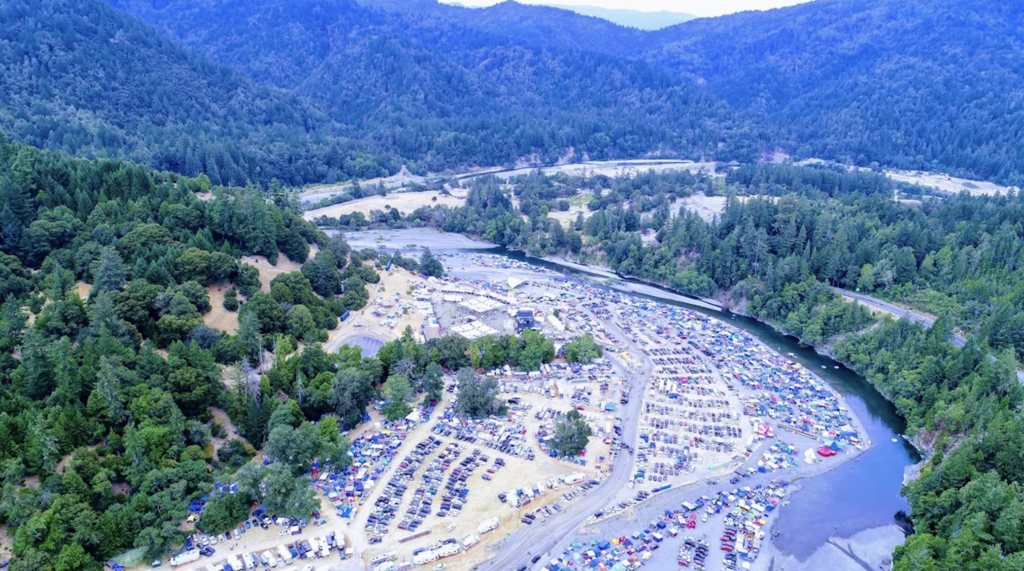
Known to locals simply as “Reggae,” it’s been a Mateel Community Center tradition since 1984. The 2025 festival was held August 1–3 at County Line Ranch (formerly Dimmick Ranch), across the Eel from the original French’s Camp site.
FRIDAY
We crossed over the Mendocino–Humboldt County line around 4:20 p.m. on Friday, August 1st. We checked into camp, got out our radio, and tuned to KMUD 91.1, the listener-supported community station out of Redway. KMUD broadcasts ROTR live every year — over-the-air and streaming online — and their press tent coverage gives listeners an inside look into the artists’ lives and viewpoints… access that at most festivals is reserved for industry media and not broadcast in full to the public.
Keznamdi was on the main stage when we tuned in. As we cooked dinner at camp, the broadcast moved to KMUD’s press tent, where Mista Chief was being interviewed about his set that afternoon — one he defined as “electric.” One artist from the All Season collective said something that stayed with me: “We are being indigenous in the biggest spaces and we’re being really loud about it.” They spoke of their work in the hip-hop and indigenous communities, the idea of having actions behind the concepts. Luciano was starting on the main stage as we packed up for the shuttle.
We caught the shuttle into the festival as the sun was going down. The shuttle stops are one of the places you really feel the mix of who shows up to Reggae — long-time attendees and first-timers riding in together, sparking conversation. Talking with another couple, we reminisced about the prior years we had collectively attended — the changes and stand-out performances.
Excitement
Arriving on-site, getting our wristbands, seeing familiar faces, and walking into the festival grounds had me giddy. We took our time to settle in, catching the last song from Yellowman, then Charly Black, who kicked off a weekend full of dancehall. Between sets we walked to the back of the bowl (main music area) and found an space a few of the event sponsors had set up as public lounges so people could sit down, be comfortable, and relax. Cozy couches, ottomans, coffee tables — the functional décor included full-length cannabis flowers on their stems in vases, plus rolling trays and papers — everything needed, and genuine Humboldt hospitality. I grabbed dinner from Spiro’s Gyros out of Ukiah. Spiro has had a booth at ROTR for 20 years, fundraising for Tree of Life Charter School since his kids were young.
Alborosie
Headlining Friday night was Alborosie, returning for the first time since 2015. During his set he told the crowd: “We gonna take it to another level. To the 4 corners of the earth. We love marijuana and we love Humboldt County; we love real people who grow weed and spread the message of the Solomon herb and the righteousness and the spiritualism that goes with the music. Don’t just smoke to smoke. Smoke to be deeper. Deeper like the ocean.” This would be a recurring theme of the festival — the power of cannabis not just to get high, but to go deeper: its spiritual properties, and the way it connects people to each other and to something greater.
SATURDAY
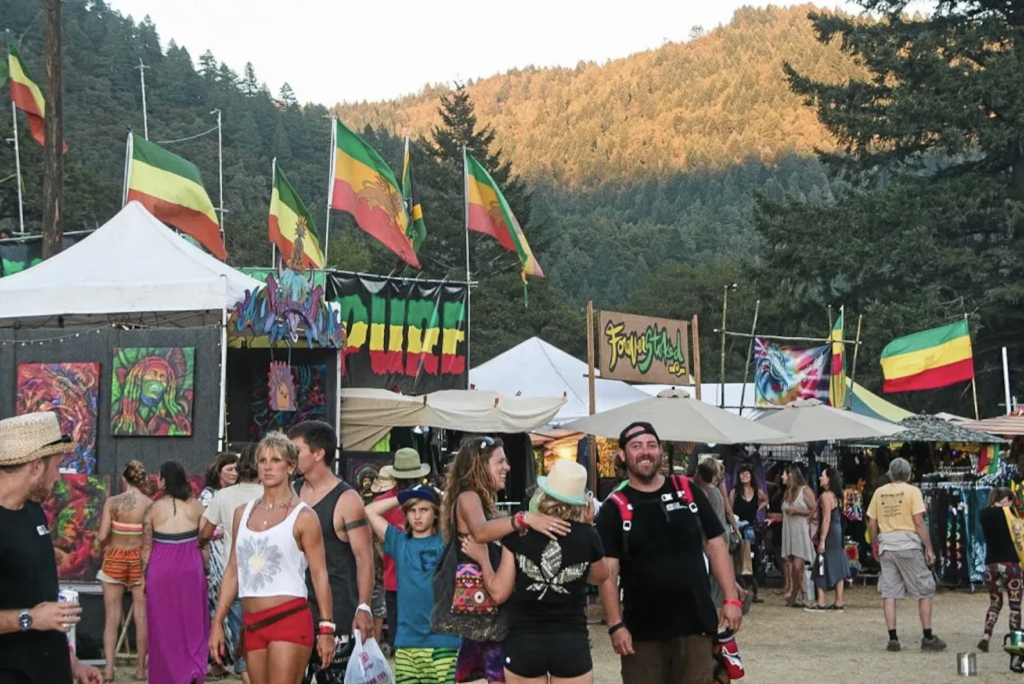
I walked into the main music area called the bowl in the heat of Saturday afternoon and stood on that beautiful land — blue skies, a slight breeze, flags from countries all over the world lining the edges of the concert bowl and waving above the vendor booths. Dreamcatchers in the trees, red-gold-and-green ribbons flowing from the branches. The bowl was just starting to fill before the first band of the day, vendors setting up booths of handmade crafts, art, international wares, food, and beverages. People come decked out, and I’ve had many memorable conversations, especially this year, about where items of clothing and jewelry came from, how long they’ve had them, and our connections to these heirlooms.
Perfect Spot
We found a shady spot under the oak tree in front of the soundboard. Listening to Massive Sound International and Spliff Skankin, we watched Spliff skanking big time (pun intended) on the elevated sound booth. He was one of my biggest influences growing up. We used to listen to him on KPFA in the San Francisco Bay Area in the 1990s and record his weekly two-hour Reggae Roadblock radio show, bootlegging the tapes and passing them around amongst friends. Spliff is now an elder to me and someone I refer to as a veteran DJ, so being there as he opened the main stage on Saturday was an honor.
Main Stage
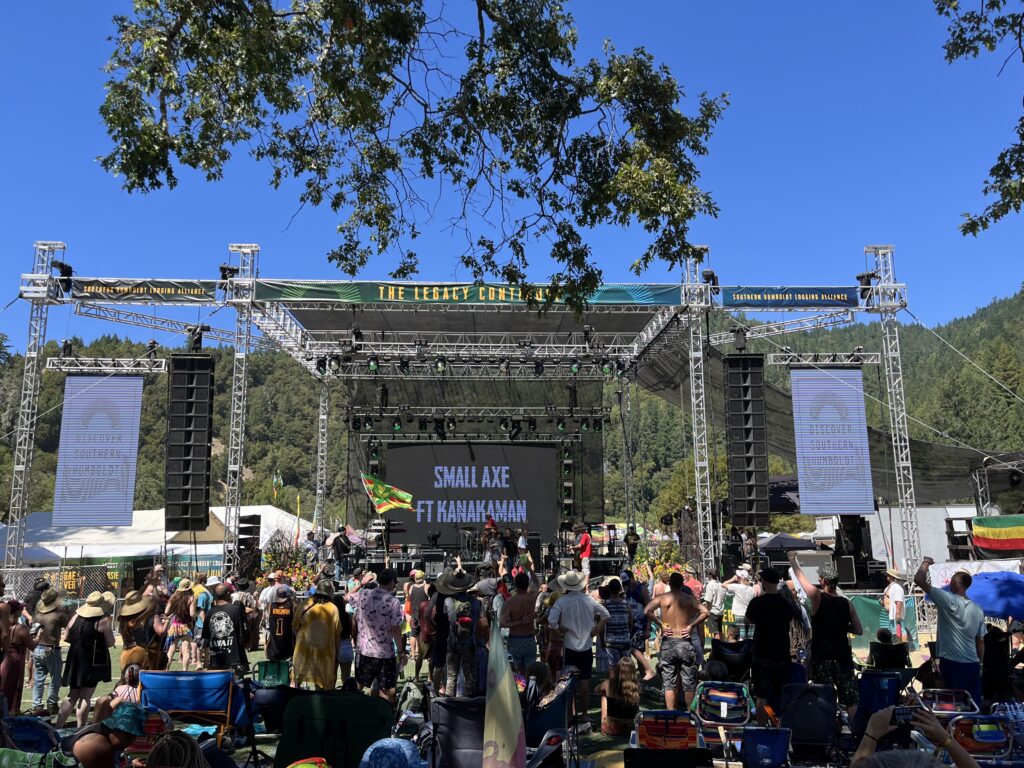
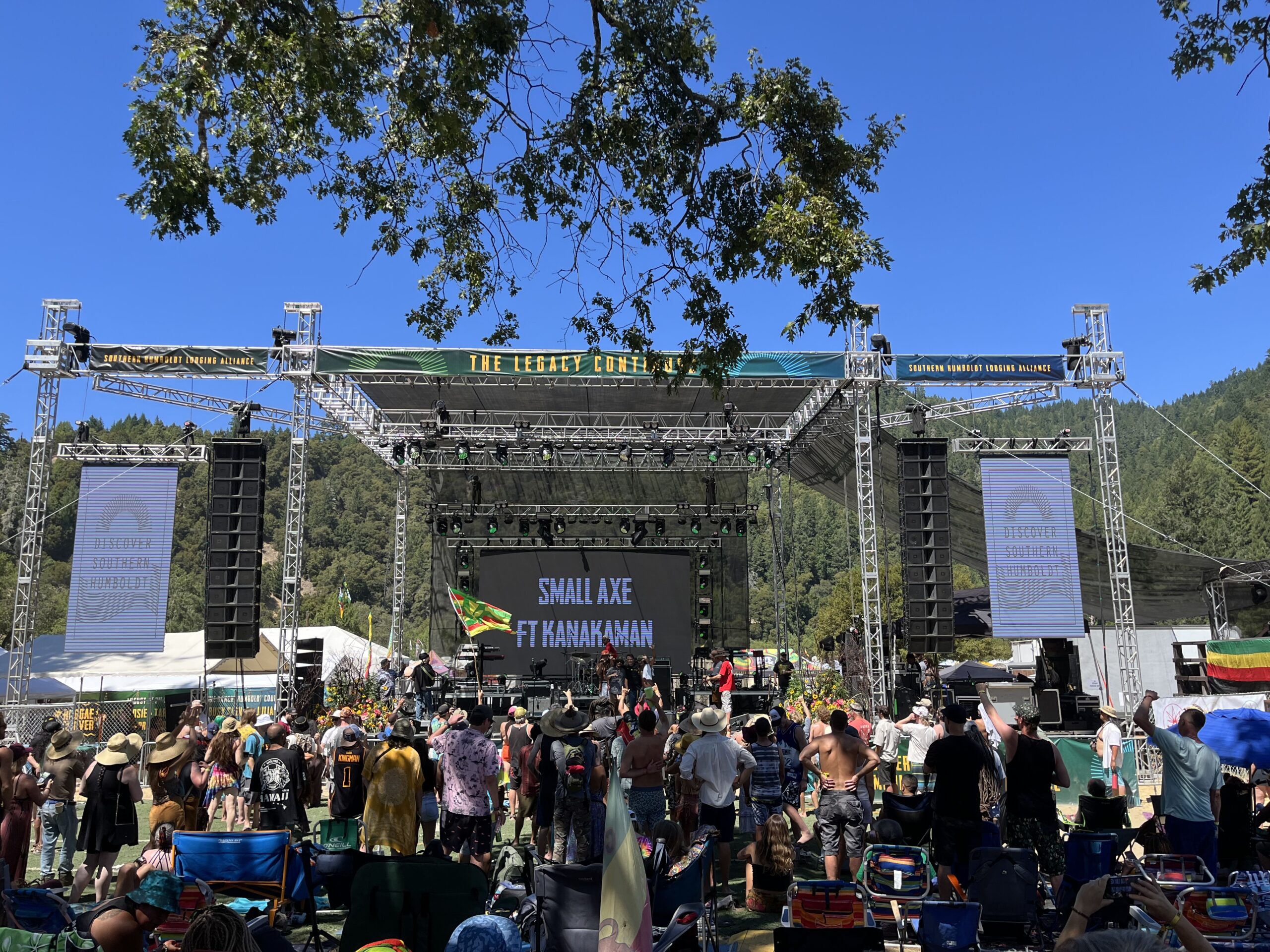
Kicking off the main stage for the day was Kanakamon & Small Axe, with Teoman joining as a welcome opening surprise, backed by Rootz N Creation — Kaleo De Mello’s Maui-based roots reggae production company and band. The lineup also featured Ryan “Ishence” Willard, who has released a deep catalog of roots albums on his Higher Bound Productions label, including multiple Akae Beka albums.
On stage, Kanakamon reminisced about having a Reggae on the River tape from 1995, saying he never dreamed he’d be playing this stage. Playing his guitar throughout the set and stepping forward as he and Small Axe played songs they’ve released together and their own solo tracks. Kanakamon called out “Fight oppression and not each other”, urging the crowd to know their history.
Small Axe playing his track “Wildfire” describes a familiar scene here in California, only from his experience of the wildfires in Hawaii. From wiping out the whole city, roadblocks, and the fire so fierce it reached boats offshore. Reggae is message music. What Teoman defined in the press tent as a heart connection, saying “the reggae message is all about the heart and connecting to your heart and soul. So, when people know you’re singing from your heart they’re gonna feel that message. Then they’re gonna open their heart.”
Powerful
Next up was Hempress Sativa. Onstage she was a powerful presence, standing firm and proud in African garments, barefoot in a gold-lined scarf. Her father, Albert “Ilawi Malawi” Johnson, was the legendary drummer and selector for Jamaica’s Jah Love Sound System where Brigadier Jerry famously toasted on the mic. She said her father played vinyl every day, from early in the morning until late at night. On stage she stopped the music, quieted the audience, and said: “You know reggae music is a revolutionary tool.
Some people just think it’s just all about dancing and having an irie vibe and smoking weed and it’s one love, but the roots of reggae music is rooted in tribulation, oppression, Black struggles; it’s pan African. So, we give gratitude to the ones who can open their hearts and minds and be receptive of the fact.”
She did this before kicking it off into “Fight For Your Rights.” She also told the crowd,: “All war is deceptive, and we must be keen to speak up and out about that fact.” In her press tent interview she said the aim is to repatriate.: “If you don’t see me for some time, you know where I’ll be. I’ll still be doing music.” We left the festival after her set, knowing we needed a break to make it through the night.
No Longer Just A Stage Show
Returning at dusk, we heard Julian Marley playing “Build Together” as we walked into the bowl. We walked fast to catch his set — his own songs and Bob Marley hits, the sun setting behind the mountains. When Julian Marley ended, we went straight over to the Stay Positive Stage to make sure we saw I-Octane. Persimmon grove on one side, food vendors on the other, picnic benches for seating and oaks dotted throughout.
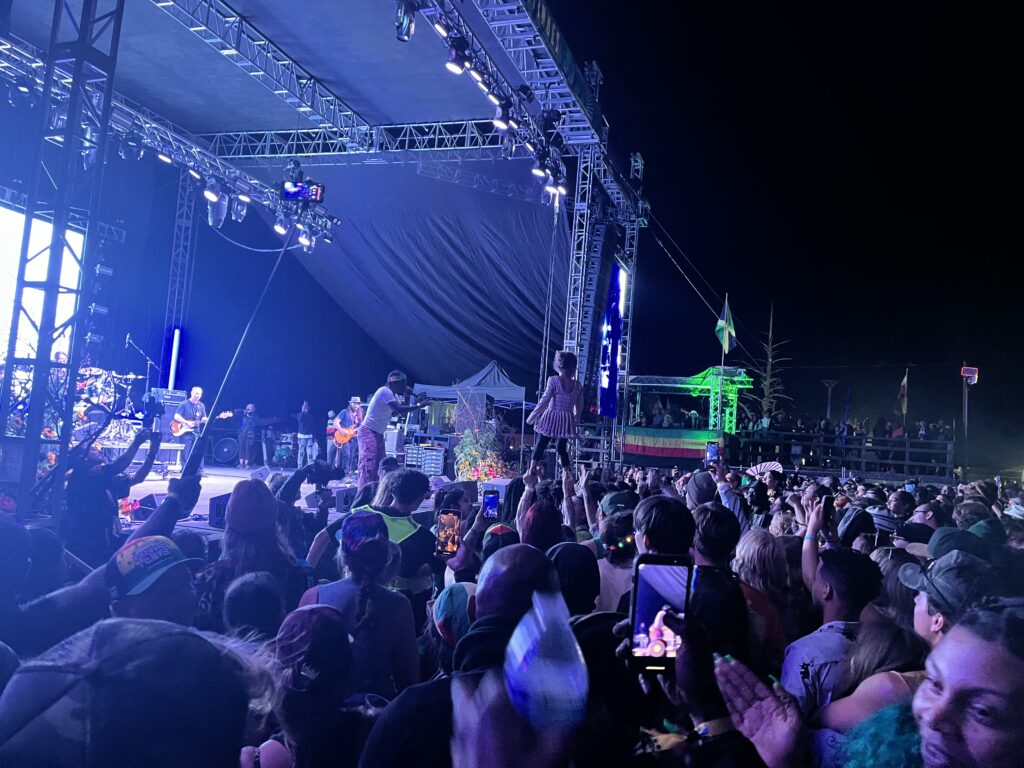
We made it just in time and minutes into I Octane’s set he called for tables as we saw multiple tables hoisted above the crowd, legs in the air, moving toward the center of the audience. He climbed up and stood on them, jumping, singing, interacting with the crowd. He’d left his band on stage and moved into the crowd, lights strung up in the trees, I-Octane in the center, the audience standing around him surprised by this impromptu moment. This was no longer just a stage show.
Dancehall
Mr. Vegas took the main stage next, with his three dancers showing the audience how to do those fast dancehall moves. One of many dancehall artists that we rarely get a chance to see in Northern California. He shared that he has been coming to Reggae on the River for over 25 years — playing a standout set at the 2001 festival — and although it had been some time since he’d been back, he bigged up the promoters for bringing dancehall to Reggae on the River.
He brought I-Octane up mid-set and split the audience left to right, calling all the fans on each side to show their support for each artist. I interpreted this as a show of respect and friendly competition, as the two hyped off each other and the crowd. Taking a break in between the set, DJ Joe Young played a tribute to artists who have passed and gone. Fresh from a wardrobe change, Mr. Vegas and his backup dancers came back out to finish the set he described as “original, authentic dancehall music. No gimmicks.”
Saturday Night Finale
Closing Saturday night was Tarrus Riley with Dean Fraser & the Blak Soil Band — Fraser, the legendary Jamaican saxophonist who produced Riley’s debut album, has anchored his live sound for nearly two decades. I’ve seen and enjoyed Tarrus close out nights before and was running low, so I used his set in the background to check out the vendors, then started the trek back to camp with carrying his music behind me.
SUNDAY
On Sunday we skipped the shuttle and brought our chairs in because we planned to be at the show the entire day. I remember recognizing how quick the weekend went by, and it was a little bittersweet being the last but longest day for us. We heard Soul Ska featuring Angelo Moore as we were walking into the bowl. We made our way past the main stage to catch Ishi Dube. His album Massagana was a staple in my household for years.
As we walked through the oak groves, picking out a shady spot to put down our chairs, I stopped to acknowledge someone wearing a 1992 ROTR T-shirt. He told me, “It’s brand new!” I asked if it was a reprint. He responded, “No! It’s original but the first time I’m wearing it!” This was Rod Deal’s son, and Ishi Dube was about to do a tribute to Rod Deal & The I-Deals during his set, a band that has played many ROTRs going back to 1986. During the tribute, Ishi told the crowd he played the 1991 album Truth & Rights “until it fell apart and he wants to keep his legacy alive and introduce his music to the younger generation.”
It’s All About The Culture
A Humboldt-raised artist, he reminded the crowd about what it was like before legalization: “We all remember the culture, and it created a strong community and that’s what we are.” He threw it back with songs like “Herbicide Danger.” Later in the set, in the intro to playing “Helicopters,” with the sound of helicopters blaring he turned to the audience: “All my OG’s, how many times did we hear this intro and think it was the real thing?”
A highlight for me was seeing him bring his kids and his niece and nephew on stage at the end to sing along with other kids from the audience — a reminder of how important this music and space are to bring us together.
VIP Area and Tiered Tickets
We’d upgraded to VIP this year on the four-payment plan, and Sunday was the day to test it. The freshly laid VIP area sat close to the stage with room to dance, luxury portable restrooms with running water, and a shaded lounge stocked with cold water, kombucha and local beer on tap, hot coffee, snacks, and a dab bar hosted by Proper Wellness. It was comfortable and never crowded.
Bugle was at the top of my list for the weekend. I hadn’t seen him live before. He’d been billed in NorCal years ago, but it hadn’t always worked out, and it felt like we were lucky to see him — especially after hearing him say in the press tent it had been challenging for him to get there.
Early in the set, you could feel a shift — everyone onstage locking in together, the energy lifting. He told the crowd he was born in Portland, Jamaica, and spent most of his life in Cooreville Gardens, Kingston 20. He reflected: “Music bring me through the ruffest part of my journeys and there’s some songs I played continuously and have helped me fi grow, have helped me fi make better decision. Them help me fight Babylon and them struggles.” He went into singing Norris Man’s 1997 single “Persistence” on the King of Kings Persistence Riddim.
High Energy
Bugle brought up Leaf of Life from Haile Cush Records and Bobo Smith from Sizzla’s Judgement Yard. As he sang the 2017 song “Rasta Party,” the three of them moved across the stage with big smiles on their faces, backup singers and band members all moving to the beat. Bugle told the crowd: “Big up every Rasta in here. We are Bobo Shanti.” Sharing that music saved his life, he played “Thank You Lord” — his 2024 collaboration with Buju Banton and Damian “Jr. Gong” Marley from his fifth studio album Apex.
I looked around at the audience, and everyone was tuned in, dancing and singing along. Weeks later, that track would win Reggae Collaboration of the Year at the 2025 Caribbean Music Awards. He closed with “What We Gonna Do.” In the press tent after, he said: “This is how I express myself. Me have to have a message in my music.” He added: “You have to educate while you entertain and entertain while you educate.”
We Are All Here Because Of Love
Romain Virgo came immediately on stage after Bugle ended, sharing the same band, his energy high as he commanded the audience with his sweet vocals and a track list that included many of his longtime fan favorites and songs from his newest album The Gentle Man. When he introduced “Mussi Mad” as one of his favorite songs, I felt the music hit and looked side stage to see Sara Lugo — who played the river stage earlier in the day — dancing, singing, and following along to the riddim.
Acknowledging how much time has passed in his career, Romain Virgo stopped to tell the crowd: “It’s good to be back here. Last time I was here was a long time ago. I was a baby.” His last appearance at Reggae on the River was at Benbow in 2012, and his catalog reflects how much growth he’s gone through since then. Listening to his lyrics, you can tell this man loves hard. He told the crowd: “We’re all here because of love & because we love reggae music.”
96 Degrees in the Shade
After Romain Virgo’s set ended, we went down to a friend’s vehicle to have a picnic dinner tailgate-style and heard Thir World starting. When they played “96 Degrees in the Shade” and went into “Reggae Ambassadors,” I knew we had to make our way back to the music as soon as possible. We listened to this legendary band play in the distance as we looked over the sea of vehicles and people, Sunday vibes mellowing as people started to depart for their daily lives. We drank and ate to recharge and went back to the main stage in time to see the majority of their set.
The band — formed in Kingston in 1973 by Stephen “Cat” Coore and Michael “Ibo” Cooper — has been at this for over fifty years. On stage they greeted the crowd: “Loving you is easy, and we’ve been here many times and it’s so good to be back.” In the press tent they said: “We give it 200% every time and it’s authentic.” They brought out Kumar Fyah, who sang a recent release with Clive Hunt — a reggae version of the Police’s “Message in a Bottle.” The lyrics about sending an SOS to the world hit differently right now, and I felt the message.
RIP Cat
Cat Coore broke out for a solo of Bob Marley’s “Redemption Song” on his cello — his signature live piece, carried across decades. He quieted the audience as he played. The person next to me turned and said that was like the Jimi Hendrix of reggae. Six months later, on January 18, 2026, Stephen “Cat” Coore passed away suddenly at 69. He was still actively touring. A reminder of how many elders and legends we have lost and how lucky we are to still see them anytime we get the chance.
Freedom
T.O.K. played next and I was pleasantly surprised, having only listened to their top hits in the past. I knew this was a band I needed to see. They were true showmen. They got me into it. When they dropped “Machine,” I was winding my hips and feeling the music as they showed us how to move, running through their catalog. The audience followed along with the call and response — “when we say T, you say OK.” It was their first ROTR appearance since their 2022 reunion, after dissolving in 2015.
They stood on stage telling the audience: “We did dancehall on the river, EDM on the river. Now can we do reggae on the river? We are one of those groups, that do almost every style of music but we’re from Jamaica. We grew up on Bob Marley, Inner Circle, Burning Spear. And we have some massive hits in the reggae world. This one is personal; we live in a world where there’s a lot of fight & conflict. There is war everywhere, but music is the only thing that can heal us from all this war. Music and I believe there’s one fundamental rule for all of us. We are all born to be free; we all have the right to be free and to live our lives as we want to live our lives.” They introduced their brand-new song “Freedom” right after, saying they believe in one love — music is the one thing that brings us together.
Connection
Queen Omega’s return to the ROTR stage was one I’d been waiting on. She hasn’t played Northern California in years, and she knew it. She told the crowd her first album came out in 2001 and recognized it had been some time since she’d been on the ROTR stage — sixteen years she guessed, which would put her last appearance at the 2009 festival at Benbow. Powerful as ever, she wore an outfit of African print and design. She spoke to the audience between songs, and I loved hearing her say: “It’s important that I feel your energy, you know it’s a connection we are spiritual beings and we’re electrical beings as well. I need to feel your electricity. I need to feel that you are connected. Bigging up the feminine energy same way.”
She asked the crowd if they wanted her to share this moment, and brought up Kenya Eugene, hailing from St. Croix, US Virgin Islands. Kenya Eugene came out standing tall on stage and sang her 2021 release “Bun It” — produced by Jalani Horton of Bambu Station. Queen Omega ended with the dubplate “Don’t Call Me Local” and, after being called up for an encore, dropped “No Love” — her viral 2023 collaboration with Little Lion Sound on the classic hip-hop-sounding “Next Episode” riddim. From the back of the crowd, I could feel it as that song dropped and had my body moving.
Moon High in the Sky
After Queen Omega we walked down to the river stage briefly to check the setup — the deck overlooking the river, moon high in the sky, the tree-lined horizon and cliff walls across the river — before returning to the bowl for Busy Signal. He started with what I’d call a hardcore dancehall set, then moved into other more mainstream songs. When he played “Watch Out For This (Bumaye),” his 2013 Major Lazer collaboration, and asked everyone to wave around their scarves, bandanas, hats — whatever they were representing — I so wish I had taken the initiative to get a video of how hyped the crowd was as they danced along, jumped up and down, and waved their items of choice in the air to the beat.
THE SEND OFF
Before the last set, a tribute video played to remember those no longer with us. After Busy Signal ended, a ROTR tradition closes the festival: organizers call up the staff and coordinators present in the bowl, thanking by name those who keep the Mateel Community Center running year-round. They closed down the show by telling the crowd to keep supporting reggae music and Reggae on the River. The final send-off to the audience: “Keep it alive. Reggae lives!”
Tickets and full lineup for the 37th annual Reggae on the River – August 14–16, 2026 can be found at reggaeontheriver.com.